Path Parameters
You can declare path "parameters" or "variables" with the same syntax used by Python format strings:
from fastapi import FastAPI

app = FastAPI()


@app.get("/items/{item_id}")
async def read_item(item_id):
    return {"item_id": item_id}
The value of the path parameter item_id will be passed to your function as the argument item_id.
So, if you run this example and go to http://127.0.0.1:8000/items/foo, you will see a response of:
{"item_id":"foo"}Path parameters with types
Section titled “Path parameters with types”You can declare the type of a path parameter in the function, using standard Python type annotations:
from fastapi import FastAPI

app = FastAPI()


@app.get("/items/{item_id}")
async def read_item(item_id: int):
    return {"item_id": item_id}
In this case, item_id is declared to be an int.
Data conversion
Section titled “Data conversion”If you run this example and open your browser at http://127.0.0.1:8000/items/3, you will see a response of:
{"item_id":3}Data validation
Section titled “Data validation”But if you go to the browser at http://127.0.0.1:8000/items/foo, you will see a nice HTTP error of:
{
  "detail": [
    {
      "type": "int_parsing",
      "loc": [
        "path",
        "item_id"
      ],
      "msg": "Input should be a valid integer, unable to parse string as an integer",
      "input": "foo"
    }
  ]
}
because the path parameter item_id had a value of "foo", which is not an int.
The same error would appear if you provided a float instead of an int, as in: http://127.0.0.1:8000/items/4.2
Documentation
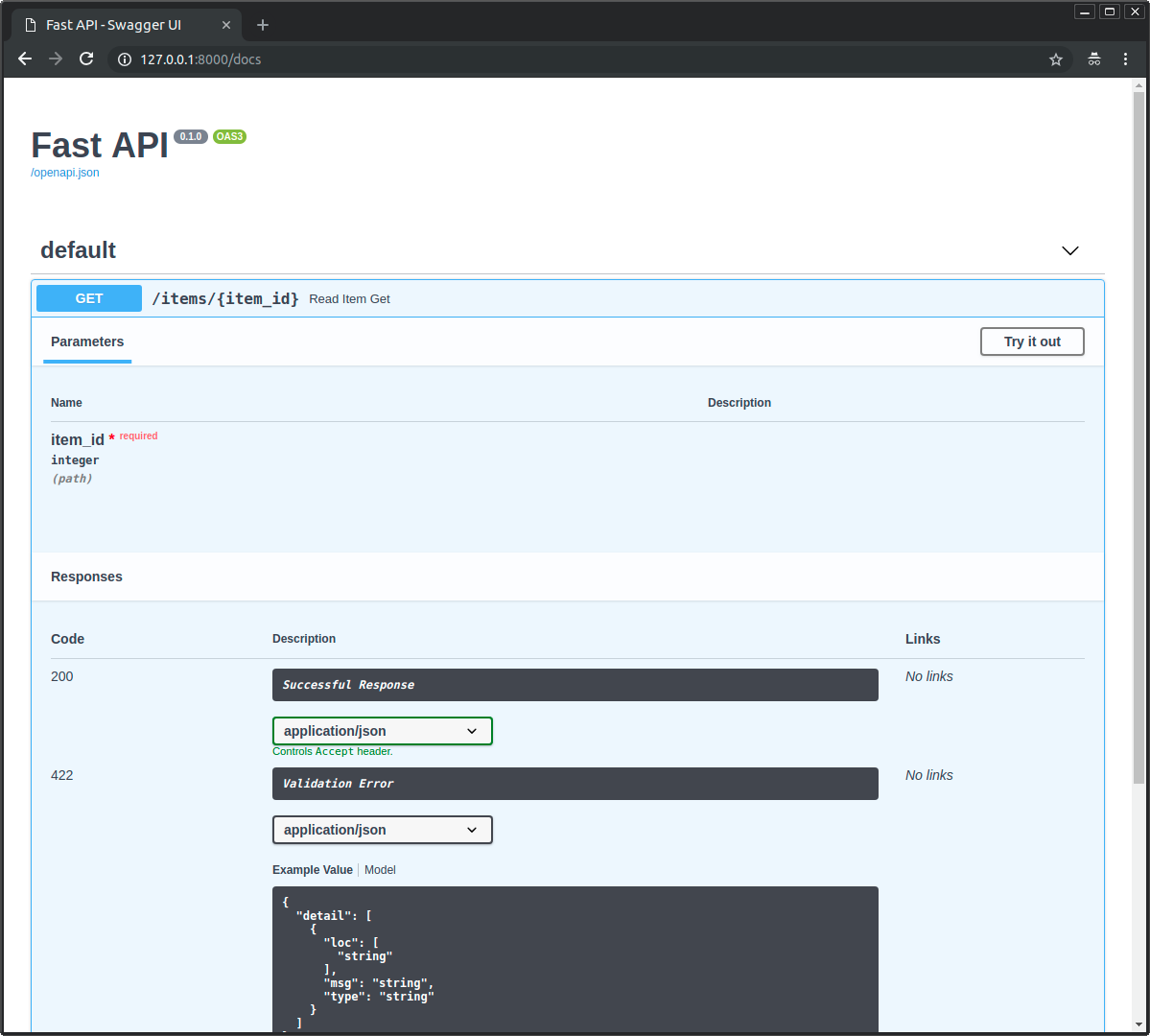
Section titled “Documentation”And when you open your browser at http://127.0.0.1:8000/docs, you will see an automatic, interactive, API documentation like:
Standards-based benefits, alternative documentation
Section titled “Standards-based benefits, alternative documentation”And because the generated schema is from the OpenAPI standard, there are many compatible tools.
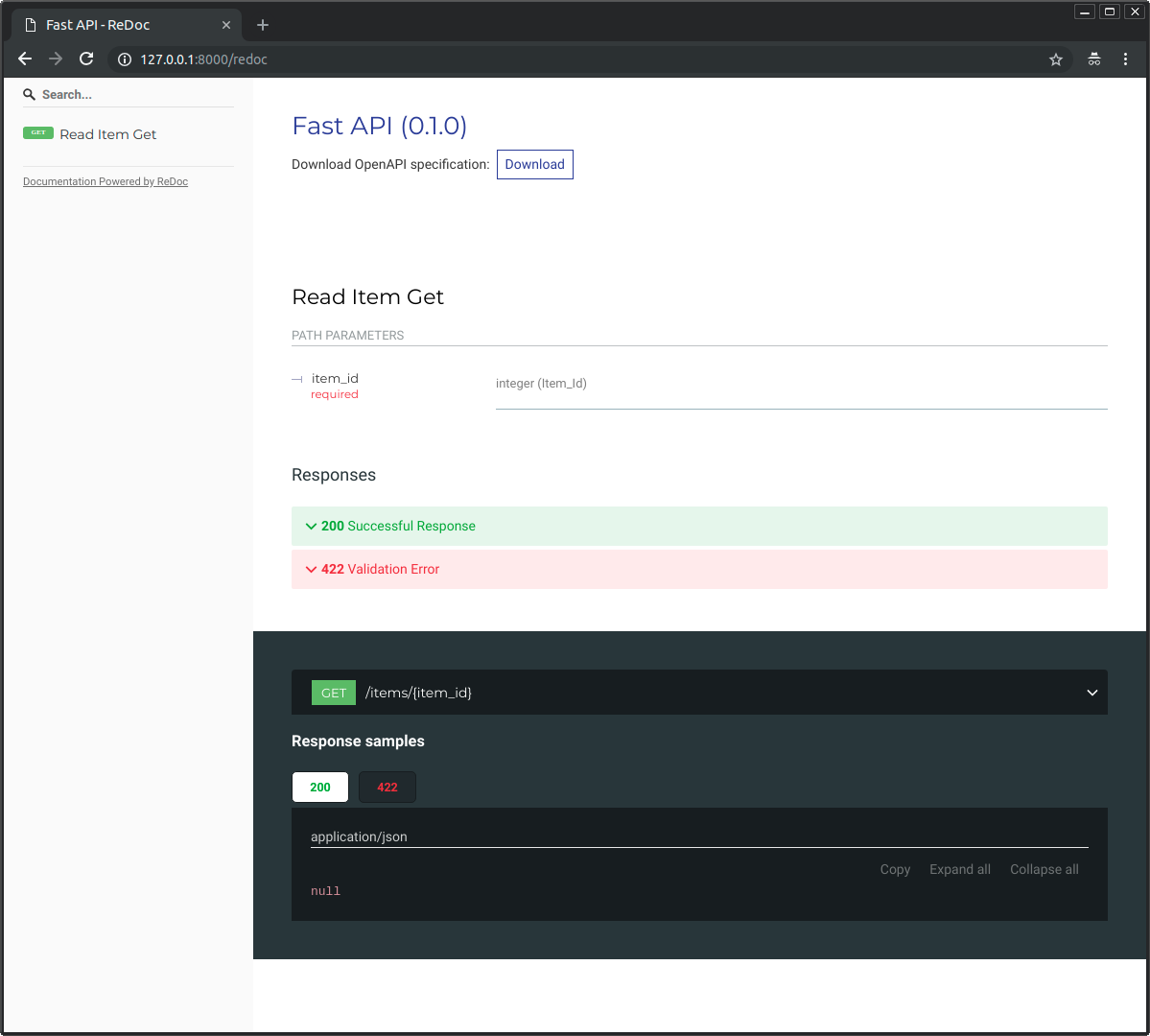
Because of this, FastAPI itself provides an alternative API documentation (using ReDoc), which you can access at http://127.0.0.1:8000/redoc:
The same way, there are many compatible tools. Including code generation tools for many languages.
Pydantic
Section titled “Pydantic”All the data validation is performed under the hood by Pydantic, so you get all the benefits from it. And you know you are in good hands.
You can use the same type declarations with str, float, bool and many other complex data types.
Several of these are explored in the next chapters of the tutorial.
Order matters
Section titled “Order matters”When creating path operations, you can find situations where you have a fixed path.
Like /users/me, let's say that it's to get data about the current user.
And then you can also have a path /users/{user_id} to get data about a specific user by some user ID.
Because path operations are evaluated in order, you need to make sure that the path for /users/me is declared before the one for /users/{user_id}:
from fastapi import FastAPI

app = FastAPI()


@app.get("/users/me")
async def read_user_me():
    return {"user_id": "the current user"}


@app.get("/users/{user_id}")
async def read_user(user_id: str):
    return {"user_id": user_id}
Otherwise, the path for /users/{user_id} would match also for /users/me, "thinking" that it's receiving a parameter user_id with a value of "me".
Similarly, you cannot redefine a path operation:
from fastapi import FastAPI

app = FastAPI()


@app.get("/users")
async def read_users():
    return ["Rick", "Morty"]


@app.get("/users")
async def read_users2():
    return ["Bean", "Elfo"]
The first one will always be used since the path matches first.
Predefined values
Section titled “Predefined values”If you have a path operation that receives a path parameter, but you want the possible valid path parameter values to be predefined, you can use a standard Python EnumEnumeration.
Create an Enum class
Section titled “Create an Enum class”Import Enum and create a sub-class that inherits from str and from Enum.
By inheriting from str the API docs will be able to know that the values must be of type string and will be able to render correctly.
Then create class attributes with fixed values, which will be the available valid values:
from enum import Enum

from fastapi import FastAPI


class ModelName(str, Enum):
    alexnet = "alexnet"
    resnet = "resnet"
    lenet = "lenet"


app = FastAPI()


@app.get("/models/{model_name}")
async def get_model(model_name: ModelName):
    if model_name is ModelName.alexnet:
        return {"model_name": model_name, "message": "Deep Learning FTW!"}

    if model_name.value == "lenet":
        return {"model_name": model_name, "message": "LeCNN all the images"}

return {"model_name": model_name, "message": "Have some residuals"}Declare a path parameter
Section titled “Declare a path parameter”Then create a path parameter with a type annotation using the enum class you created (ModelName):
from enum import Enum

from fastapi import FastAPI


class ModelName(str, Enum):
    alexnet = "alexnet"
    resnet = "resnet"
    lenet = "lenet"


app = FastAPI()


@app.get("/models/{model_name}")
async def get_model(model_name: ModelName):
    if model_name is ModelName.alexnet:
        return {"model_name": model_name, "message": "Deep Learning FTW!"}

    if model_name.value == "lenet":
        return {"model_name": model_name, "message": "LeCNN all the images"}

    return {"model_name": model_name, "message": "Have some residuals"}
Check the docs
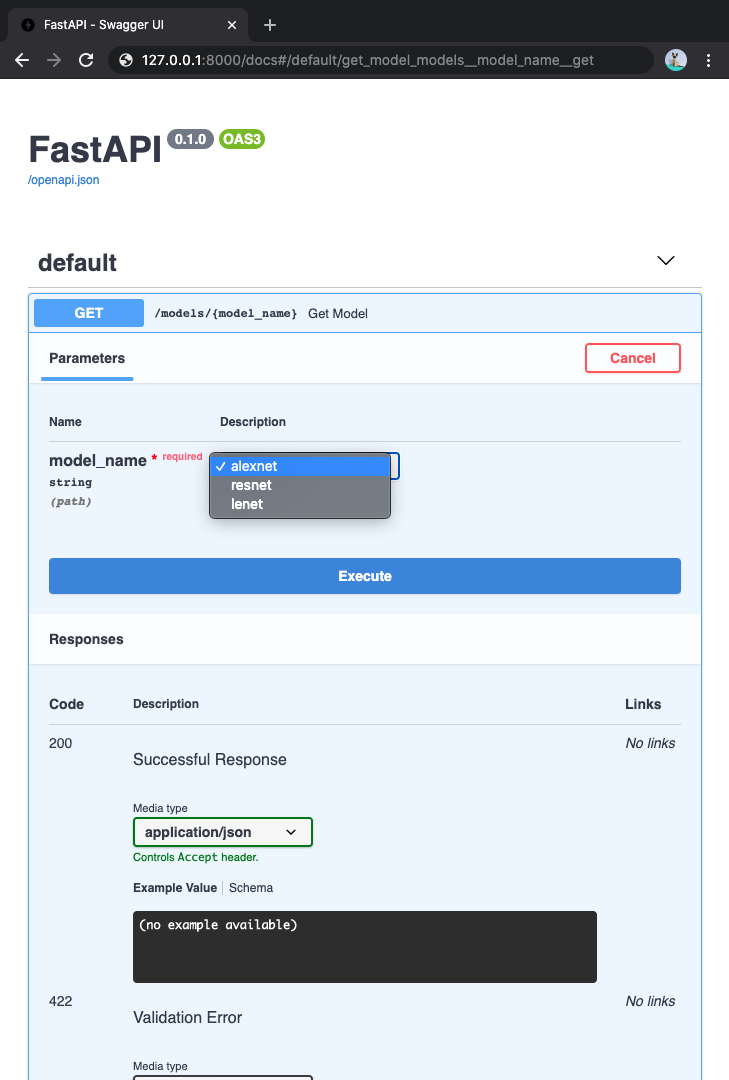
Section titled “Check the docs”Because the available values for the path parameter are predefined, the interactive docs can show them nicely:
Working with Python enumerations
Section titled “Working with Python enumerations”The value of the path parameter will be an enumeration member.
Compare enumeration members
Section titled “Compare enumeration members”You can compare it with the enumeration member in your created enum ModelName:
from enum import Enum

from fastapi import FastAPI


class ModelName(str, Enum):
    alexnet = "alexnet"
    resnet = "resnet"
    lenet = "lenet"


app = FastAPI()


@app.get("/models/{model_name}")
async def get_model(model_name: ModelName):
    if model_name is ModelName.alexnet:
        return {"model_name": model_name, "message": "Deep Learning FTW!"}

    if model_name.value == "lenet":
        return {"model_name": model_name, "message": "LeCNN all the images"}

    return {"model_name": model_name, "message": "Have some residuals"}
Get the enumeration value
Section titled “Get the enumeration value”You can get the actual value (a str in this case) using model_name.value, or in general, your_enum_member.value:
from enum import Enum

from fastapi import FastAPI


class ModelName(str, Enum):
    alexnet = "alexnet"
    resnet = "resnet"
    lenet = "lenet"


app = FastAPI()


@app.get("/models/{model_name}")
async def get_model(model_name: ModelName):
    if model_name is ModelName.alexnet:
        return {"model_name": model_name, "message": "Deep Learning FTW!"}

    if model_name.value == "lenet":
        return {"model_name": model_name, "message": "LeCNN all the images"}

return {"model_name": model_name, "message": "Have some residuals"}Return enumeration members
Section titled “Return enumeration members”You can return enum members from your path operation, even nested in a JSON body (e.g. a dict).
They will be converted to their corresponding values (strings in this case) before returning them to the client:
from enum import Enum

from fastapi import FastAPI


class ModelName(str, Enum):
    alexnet = "alexnet"
    resnet = "resnet"
    lenet = "lenet"


app = FastAPI()


@app.get("/models/{model_name}")
async def get_model(model_name: ModelName):
    if model_name is ModelName.alexnet:
        return {"model_name": model_name, "message": "Deep Learning FTW!"}

    if model_name.value == "lenet":
        return {"model_name": model_name, "message": "LeCNN all the images"}

    return {"model_name": model_name, "message": "Have some residuals"}
In your client you will get a JSON response like:
{
  "model_name": "alexnet",
  "message": "Deep Learning FTW!"
}
Path parameters containing paths
Section titled “Path parameters containing paths”Let's say you have a path operation with a path /files/{file_path}.
But you need file_path itself to contain a path, like home/johndoe/myfile.txt.
So, the URL for that file would be something like: /files/home/johndoe/myfile.txt.
OpenAPI support
Section titled “OpenAPI support”OpenAPI doesn't support a way to declare a path parameter to contain a path inside, as that could lead to scenarios that are difficult to test and define.
Nevertheless, you can still do it in FastAPI, using one of the internal tools from Starlette.
And the docs would still work, although not adding any documentation telling that the parameter should contain a path.
Path convertor
Section titled “Path convertor”Using an option directly from Starlette you can declare a path parameter containing a path using a URL like:
/files/{file_path:path}In this case, the name of the parameter is file_path, and the last part, :path, tells it that the parameter should match any path.
So, you can use it with:
from fastapi import FastAPI

app = FastAPI()


@app.get("/files/{file_path:path}")
async def read_file(file_path: str):
return {"file_path": file_path}With FastAPI, by using short, intuitive and standard Python type declarations, you get:
- Editor support: error checks, autocompletion, etc.
- Data "parsing"
- Data validation
- API annotation and automatic documentation
And you only have to declare them once.
That's probably the main visible advantage of FastAPI compared to alternative frameworks (apart from the raw performance).