Dependencies
FastAPI has a very powerful but intuitive Dependency Injection system.
It is designed to be very simple to use, and to make it very easy for any developer to integrate other components with FastAPI.
What is "Dependency Injection"
Section titled “What is "Dependency Injection"”"Dependency Injection" means, in programming, that there is a way for your code (in this case, your path operation functions) to declare things that it requires to work and use: "dependencies".
And then, that system (in this case FastAPI) will take care of doing whatever is needed to provide your code with those needed dependencies ("inject" the dependencies).
This is very useful when you need to:
- Have shared logic (the same code logic again and again).
- Share database connections.
- Enforce security, authentication, role requirements, etc.
- And many other things...
All these, while minimizing code repetition.
First Steps
Section titled “First Steps”Let's see a very simple example. It will be so simple that it is not very useful, for now.
But this way we can focus on how the Dependency Injection system works.
Create a dependency, or "dependable"
Section titled “Create a dependency, or "dependable"”Let's first focus on the dependency.
It is just a function that can take all the same parameters that a path operation function can take:
from typing import Annotated

from fastapi import Depends, FastAPI

app = FastAPI()


async def common_parameters(q: str | None = None, skip: int = 0, limit: int = 100):
    return {"q": q, "skip": skip, "limit": limit}


@app.get("/items/")
async def read_items(commons: Annotated[dict, Depends(common_parameters)]):
    return commons


@app.get("/users/")
async def read_users(commons: Annotated[dict, Depends(common_parameters)]):
    return commons
That's it.
2 lines.
And it has the same shape and structure that all your path operation functions have.
You can think of it as a path operation function without the "decorator" (without the @app.get("/some-path")).
And it can return anything you want.
In this case, this dependency expects:
- An optional query parameter
qthat is astr. - An optional query parameter
skipthat is anint, and by default is0. - An optional query parameter
limitthat is anint, and by default is100.
And then it just returns a dict containing those values.
Import Depends
Section titled “Import Depends”from typing import Annotated
from fastapi import Depends, FastAPI
app = FastAPI()
async def common_parameters(q: str | None = None, skip: int = 0, limit: int = 100):
return {"q": q, "skip": skip, "limit": limit}
@app.get("/items/")
async def read_items(commons: Annotated[dict, Depends(common_parameters)]):
return commons
@app.get("/users/")
async def read_users(commons: Annotated[dict, Depends(common_parameters)]):
return commonsDeclare the dependency, in the "dependant"
Section titled “Declare the dependency, in the "dependant"”The same way you use Body, Query, etc. with your path operation function parameters, use Depends with a new parameter:
from typing import Annotated

from fastapi import Depends, FastAPI

app = FastAPI()


async def common_parameters(q: str | None = None, skip: int = 0, limit: int = 100):
    return {"q": q, "skip": skip, "limit": limit}


@app.get("/items/")
async def read_items(commons: Annotated[dict, Depends(common_parameters)]):
    return commons


@app.get("/users/")
async def read_users(commons: Annotated[dict, Depends(common_parameters)]):
return commonsAlthough you use Depends in the parameters of your function the same way you use Body, Query, etc, Depends works a bit differently.
You only give Depends a single parameter.
This parameter must be something like a function.
You don't call it directly (don't add the parenthesis at the end), you just pass it as a parameter to Depends().
And that function takes parameters in the same way that path operation functions do.
Whenever a new request arrives, FastAPI will take care of:
- Calling your dependency ("dependable") function with the correct parameters.
- Get the result from your function.
- Assign that result to the parameter in your path operation function.
This way you write shared code once and FastAPI takes care of calling it for your path operations.
Share Annotated dependencies
Section titled “Share Annotated dependencies”In the examples above, you see that there's a tiny bit of code duplication.
When you need to use the common_parameters() dependency, you have to write the whole parameter with the type annotation and Depends():
commons: Annotated[dict, Depends(common_parameters)]But because we are using Annotated, we can store that Annotated value in a variable and use it in multiple places:
from typing import Annotated

from fastapi import Depends, FastAPI

app = FastAPI()


async def common_parameters(q: str | None = None, skip: int = 0, limit: int = 100):
    return {"q": q, "skip": skip, "limit": limit}


CommonsDep = Annotated[dict, Depends(common_parameters)]


@app.get("/items/")
async def read_items(commons: CommonsDep):
    return commons


@app.get("/users/")
async def read_users(commons: CommonsDep):
return commonsThe dependencies will keep working as expected, and the best part is that the type information will be preserved, which means that your editor will be able to keep providing you with autocompletion, inline errors, etc. The same for other tools like mypy.
This will be especially useful when you use it in a large code base where you use the same dependencies over and over again in many path operations.
To async or not to async
Section titled “To async or not to async”As dependencies will also be called by FastAPI (the same as your path operation functions), the same rules apply while defining your functions.
You can use async def or normal def.
And you can declare dependencies with async def inside of normal def path operation functions, or def dependencies inside of async def path operation functions, etc.
It doesn't matter. FastAPI will know what to do.
Integrated with OpenAPI
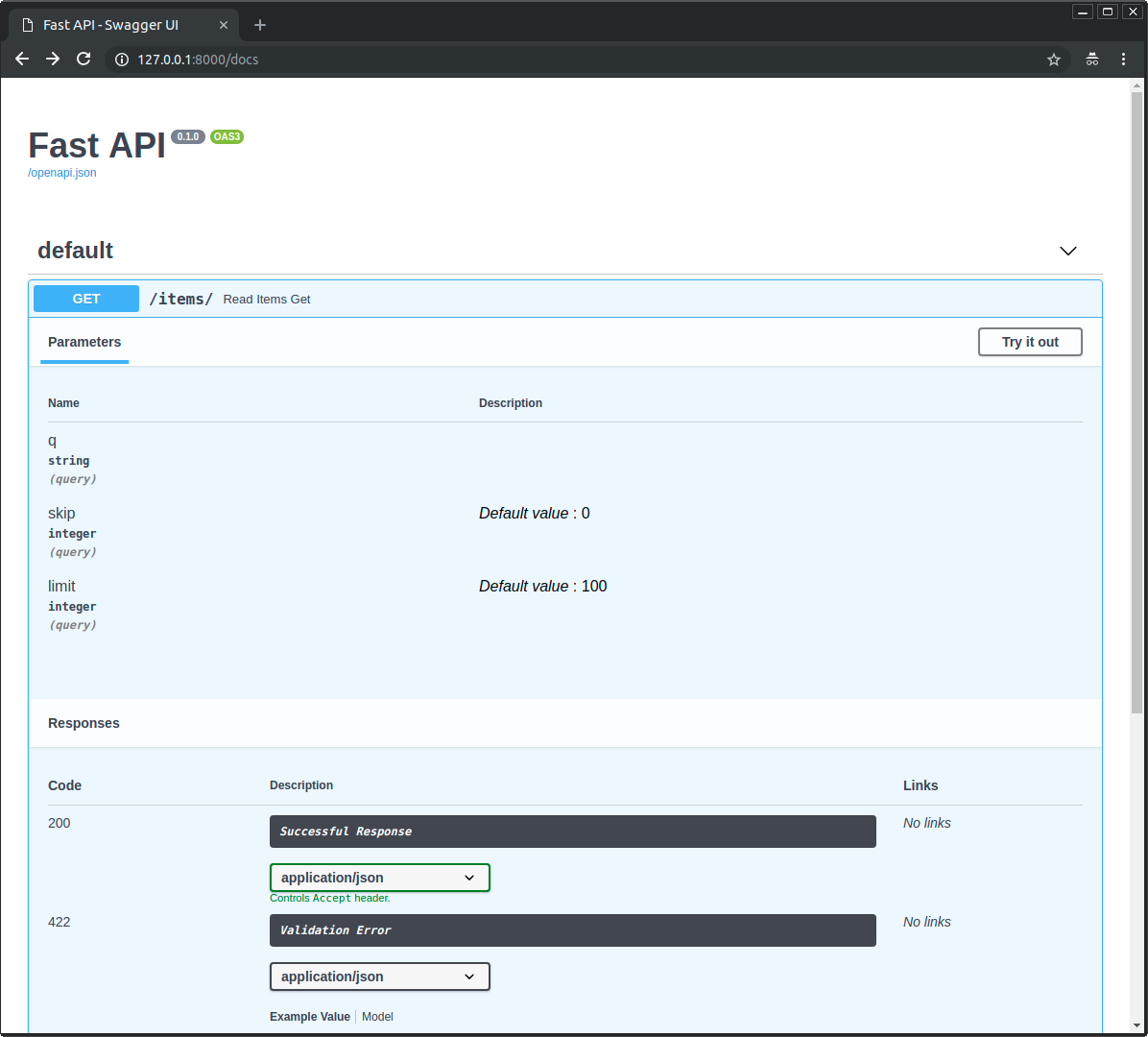
Section titled “Integrated with OpenAPI”All the request declarations, validations and requirements of your dependencies (and sub-dependencies) will be integrated in the same OpenAPI schema.
So, the interactive docs will have all the information from these dependencies too:
Simple usage
Section titled “Simple usage”If you look at it, path operation functions are declared to be used whenever a path and operation matches, and then FastAPI takes care of calling the function with the correct parameters, extracting the data from the request.
Actually, all (or most) of the web frameworks work in this same way.
You never call those functions directly. They are called by your framework (in this case, FastAPI).
With the Dependency Injection system, you can also tell FastAPI that your path operation function also "depends" on something else that should be executed before your path operation function, and FastAPI will take care of executing it and "injecting" the results.
Other common terms for this same idea of "dependency injection" are:
- resources
- providers
- services
- injectables
- components
FastAPI plug-ins
Section titled “FastAPI plug-ins”Integrations and "plug-ins" can be built using the Dependency Injection system. But in fact, there is actually no need to create "plug-ins", as by using dependencies it's possible to declare an infinite number of integrations and interactions that become available to your path operation functions.
And dependencies can be created in a very simple and intuitive way that allows you to just import the Python packages you need, and integrate them with your API functions in a couple of lines of code, literally.
You will see examples of this in the next chapters, about relational and NoSQL databases, security, etc.
FastAPI compatibility
Section titled “FastAPI compatibility”The simplicity of the dependency injection system makes FastAPI compatible with:
- all the relational databases
- NoSQL databases
- external packages
- external APIs
- authentication and authorization systems
- API usage monitoring systems
- response data injection systems
- etc.
Simple and Powerful
Section titled “Simple and Powerful”Although the hierarchical dependency injection system is very simple to define and use, it's still very powerful.
You can define dependencies that in turn can define dependencies themselves.
In the end, a hierarchical tree of dependencies is built, and the Dependency Injection system takes care of solving all these dependencies for you (and their sub-dependencies) and providing (injecting) the results at each step.
For example, let's say you have 4 API endpoints (path operations):
/items/public//items/private//users/{user_id}/activate/items/pro/
then you could add different permission requirements for each of them just with dependencies and sub-dependencies:
Integrated with OpenAPI
Section titled “Integrated with OpenAPI”All these dependencies, while declaring their requirements, also add parameters, validations, etc. to your path operations.
FastAPI will take care of adding it all to the OpenAPI schema, so that it is shown in the interactive documentation systems.